Oral-Facial Therapy in Hollywood, FL
The only hands-on work here that happens above the neck and, if you agree to it, inside your mouth.
What is oral-facial therapy?
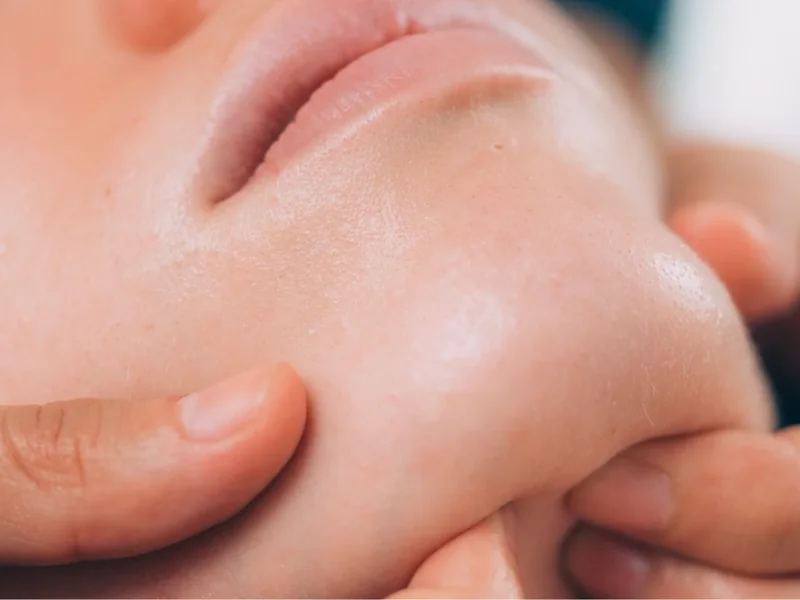
Oral-facial therapy treats the soft tissue of the jaw, face, tongue, lips, and floor of the mouth. Those tissues never get a day off. You chew with them, swallow with them all day, shape every word with them, and breathe past them all night. When the fascia and muscle there tighten or lose their coordination, the result is rarely subtle: jaw ache, clicking, headaches that start at the temples, trouble chewing or swallowing, speech that tires you out, a mouth that never finds a comfortable resting position. Treatment has two halves. The first is release, working the fascia of the face and jaw from the outside and, where it is needed and you have agreed to it, from inside the mouth with a gloved finger. The second is retraining: teaching the tongue where to rest, rebuilding the coordination of a swallow, and correcting the head and neck position that keeps pulling the jaw back out of place.
This is also the work used after a tongue-tie or lip-tie release. Cutting the restriction is the surgical part. Getting the tongue to move in a genuinely new way afterwards is the therapy part, and one without the other tends to disappoint people. Visits run 30 to 60 minutes, one on one, in a private room, and you go home with exercises, because change here is built out of small daily repetitions rather than time on a table. Florida is a direct-access state, so no physician referral is needed to start. For what visits cost, call (954) 842-3825 and ask for Ronda. If jaw pain is the reason you are reading this, the TMJ and TMD page goes into more depth on the condition itself.
Who oral-facial therapy in Hollywood helps.
This is for symptoms that live in the jaw, mouth, and face, and for the everyday functions that depend on them: chewing, swallowing, speaking, and breathing.
A jaw that aches, clicks, or will not open
You wake with a tight jaw and a headache sitting behind your temples. Anything firm to chew becomes a calculation, and the click when you yawn has started to worry you. Releasing the jaw muscles and the tissue inside the cheek, then retraining where the jaw rests and how it opens, addresses both the tension and the habit rebuilding it.
Recovery after a tongue-tie or lip-tie release
The frenulum was released and everyone expected the rest to follow on its own. Often it does not, because a tongue that spent years compensating does not automatically learn a new pattern. Post-release work keeps the site mobile while it heals and rebuilds tongue elevation, cupping, and coordination so the procedure delivers what it was meant to.
Swallowing, speech, and mouth breathing
Food catches. Certain sounds tire you out by the afternoon. You sleep with your mouth open and wake up dry. These are coordination problems as much as tissue problems, so treatment pairs release of the tight structures with myofunctional retraining of the tongue, lips, and swallow until the new pattern runs without you thinking about it.
What to expect in a session.
Nothing goes into your mouth without a conversation first. That is the rule, and it does not bend.
Assessment and consent
Your therapist looks at how your jaw opens, how your tongue moves and where it rests, how you swallow, and how you carry your head and neck. Then they explain exactly what intraoral work would involve and what it is for. You decide before anything begins, and declining changes nothing else about your care.
Release, outside then inside
External work along the jaw, temples, and neck comes first. Intraoral work, if you have agreed to it, uses a gloved finger against the inside of the cheek, the floor of the mouth, or under the tongue. Most people find it strange rather than painful. Gag sensitivity is common and easy to work around, and a raised hand stops everything.
Retraining and home practice
You practice tongue position, jaw opening, or a corrected swallow while your therapist watches and cues you, so you are not guessing later. Most people leave with a jaw that feels loose and slightly tired, as though it has done something. The exercises are short and frequent, and they decide whether the release holds.
Intraoral treatment is always optional and always explained before it happens. Tell your therapist about recent dental or oral surgery, active mouth sores or infection, orthodontic hardware, a history of jaw dislocation, a latex allergy, or a strong gag reflex. Tell them too if there is any history that makes touch near your face difficult, and say only as much about it as you want to. Any of these can be worked around, the approach adjusted, or the internal portion left out entirely. Consent here is continuous, not a form you sign once at the front desk. You can stop at any point in any session, and nothing about the rest of your care changes.
I cannot say enough amazing things about Dr. Leslie! She has truly changed my life. From the very first visit, she was professional, kind, and extremely knowledgeable.