Myofascial Release in Hollywood, FL
Fascia does not respond to force. It responds to a hand that stays in one place long enough for the tissue to let go on its own.
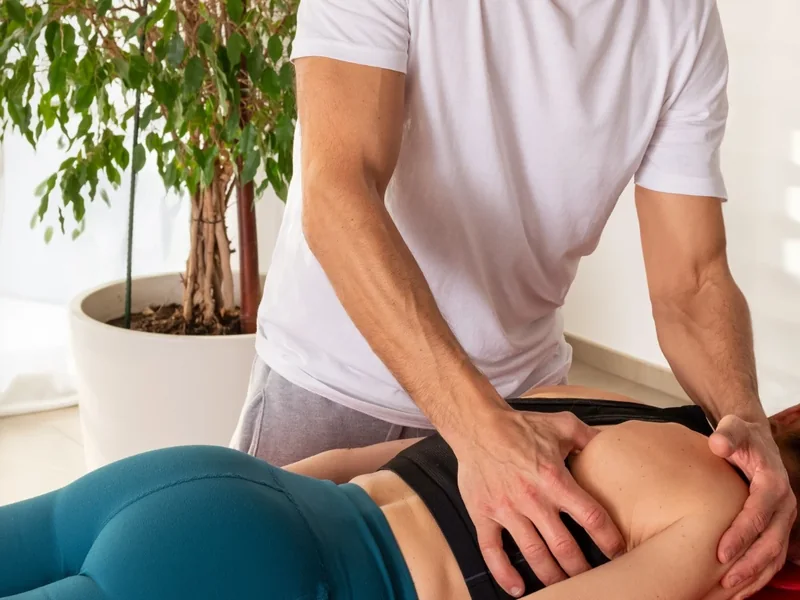
What is myofascial release?
Fascia is the continuous connective tissue that wraps every muscle, nerve, and organ you have, including everything inside your pelvis. When part of that web tightens, it does not stay politely where it started. It pulls on whatever it is attached to, which is how a restriction in the abdominal wall ends up being felt as hip pain, or a tight band along the inner thigh ends up being felt as burning at the vaginal opening. Myofascial release treats the web rather than the sore spot. Your therapist sinks slowly into the restricted layer with a hand or forearm, finds the barrier where the tissue stops giving, and then stops pushing. The contact holds there for minutes, not seconds. Somewhere inside that hold the tissue softens and lengthens on its own. The waiting is not a preamble to the technique. The waiting is the technique.
This is the slowest work done here and the least interesting to watch. No oil, no gliding, no rhythm. One hand in one place while the clock runs, which is why a visit can spend most of its 30 to 60 minutes on a single region and still be a full session. It is one on one in a private room, and where the restriction sits inside the pelvis, internal release is explained before it is offered and stopped the moment you ask. No physician referral is needed to book in Florida. For anything to do with what visits cost, call (954) 842-3825 and ask for Ronda, who will give you the real figure before you commit.
Who myofascial release in Hollywood helps.
This suits pain that will not sit still on a diagram. If you cannot point to one spot, if the ache moves week to week, or if the tender place and the painful place are not the same place, fascia is worth investigating.
Pain that refuses to stay in one place
Some days it is the tailbone. Some days the front of the hip. Some days a deep ache you cannot put a finger on at all. You have been examined more than once and nothing looked wrong, which was meant to be reassuring and was not. Fascia crosses all of those areas, so one restriction can produce a symptom map that no single muscle explains.
Scars that still pull years later
A c-section line, a perineal repair, an old laparoscopy port. The skin closed a long time ago, but the layers underneath knitted to each other and stopped sliding. You notice it as tugging when you reach, as pressure after standing a while, or as pain with penetration. Sustained release works those layers apart without forcing them.
A pelvic floor that never fully switches off
You have been told to relax, which is unhelpful instruction for a muscle that no longer remembers how. When the fascia around the pelvic floor, hips, and abdomen is held short, the muscle inside it stays short too. Long, patient release lowers the resting tension, so the down-training you practice at home has somewhere to go.
What to expect in a session.
Expect a quiet visit. Very little happens quickly, and none of that is an accident.
Mapping the pull
Your therapist watches how you move, then works over the area by hand to find where the tissue stops gliding. They will often begin somewhere you did not expect, because fascia refers pain away from its source. You are told where they are going and why before they settle in anywhere.
The hold
Pressure goes on and stays on. In a genuinely restricted area it can be uncomfortable in a dull, spreading way that most people describe as familiar rather than sharp. It should never make you brace or hold your breath. When the tissue gives underneath, that is the release, and your therapist felt it happen too.
After the release
You move through the range that has opened up, then you go home. Most people feel loose and slightly tired, and mild soreness over the next day or two is normal, close to how unfamiliar exercise feels. Water and gentle movement that evening tend to hold the change better than lying down.
Myofascial release is not a deep tissue massage, and pressing harder is not a shortcut. Force makes fascia guard, which is the opposite of what the technique is for. It is also not a replacement for the strengthening and coordination work that comes after it, because tissue that has been freed will slowly shorten again if nothing new asks it to stay long. The release buys you the range. The exercise is what keeps it.
I recently had the pleasure of working with Leslie, and I couldn't be more grateful for the experience. From the moment we met, Leslie's warmth and genuine care put me at ease.